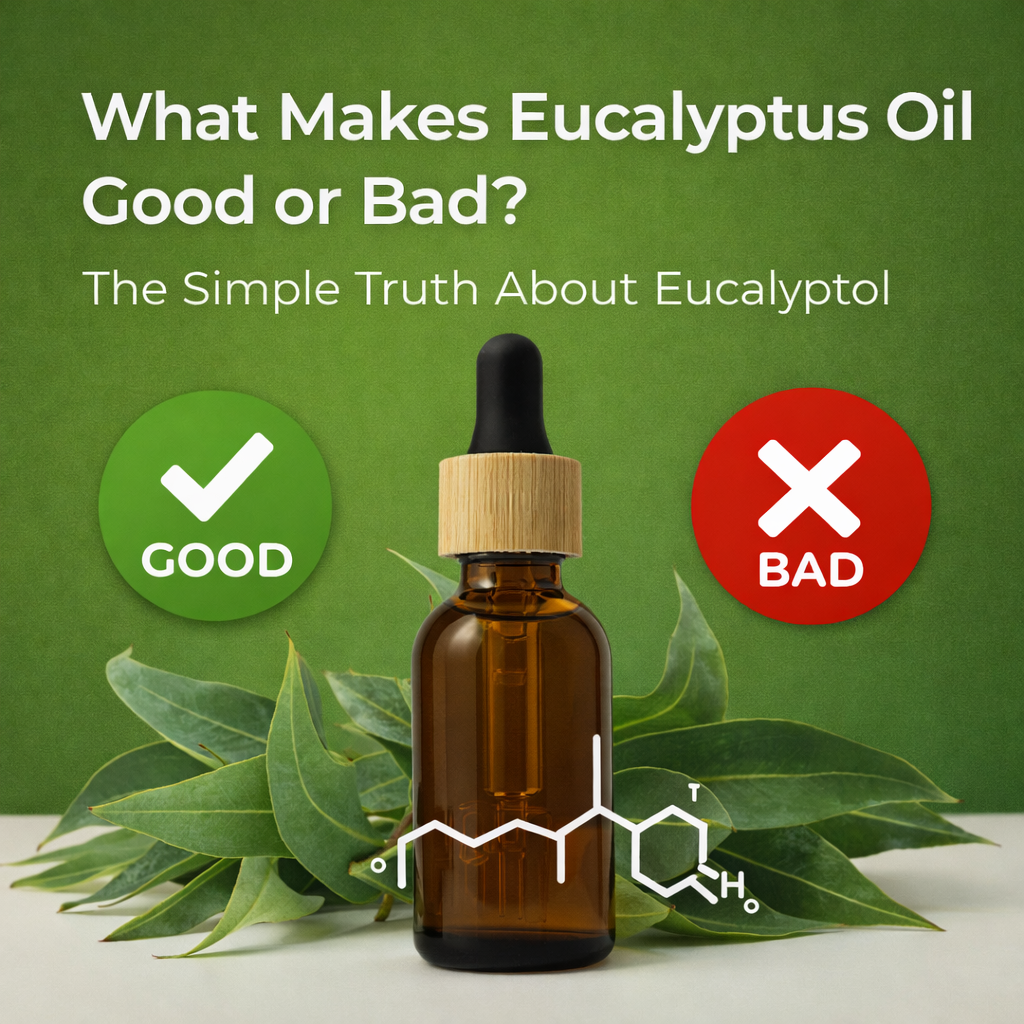
If you've ever bought eucalyptus oil and wondered why one bottle works brilliantly while another barely smells right, the answer is almost always one thing: how much eucalyptol it contains.
Here's what you need to know, in plain terms.
What is Eucalyptol and Why Does it Matter?
Eucalyptol (also written as 1,8-cineole) is the main active compound in eucalyptus oil. Think of it as the "engine" of the oil. It's the part that:
- Opens up airways and helps you breathe easier (which is why it's in cough syrups and chest rubs)
- Kills bacteria and fungi (which is why it works in mouthwash and antiseptic products)
- Gives eucalyptus oil that sharp, fresh, unmistakable scent (which is why it's used in perfumes, cleaning products, and aromatherapy)
A high-quality Eucalyptus globulus oil, the species used for pharmaceutical and cosmetic manufacturing, should contain 70–85% eucalyptol. Below that, and the oil either won't perform the way your formulation needs it to, or it's been diluted or adulterated.
How Do You Actually Verify the Eucalyptol Content?
The industry-standard method is called GC-MS, Gas Chromatography–Mass Spectrometry. It's basically a scientific fingerprinting test that identifies every compound in the oil and tells you exactly what percentage each one makes up.
When you buy eucalyptus oil in bulk, always ask for:
- GC-MS report — shows the full chemical breakdown of that specific batch
- Certificate of Analysis (CoA) — confirms key quality parameters, including eucalyptol %
- MSDS — Material Safety Data Sheet for safe storage and handling
If a supplier can't or won't provide these three documents, that's your signal to look elsewhere.
A common problem in the market: cheaper Eucalyptus citriodora oil (which smells lemony and contains almost no eucalyptol) gets blended into E. Globulus oil to cut costs. The blend might pass a visual or smell check, but will fail any proper lab test and fail in your formulation.
Why Steam Distillation is the Only Method Worth Trusting
Eucalyptus oil for pharmaceutical or cosmetic use should always be steam-distilled. Here's why it matters:
In steam distillation, only steam passes through the plant material, no chemicals, no solvents. What comes out is a pure, solvent-free oil with a natural compound profile. That's what regulators expect, what pharmacopoeias specify, and what your formulations actually need.
Some cheaper extraction methods use solvents, which leave behind trace chemical residues and alter the natural eucalyptol profile. These oils are fine for industrial uses (floor cleaners, degreasers) but are not acceptable for pharmaceutical, cosmetic, or food applications.
The Standards That Matter for Export Buyers
If you're importing eucalyptus oil from India for regulated markets, here's what to confirm with your supplier:
- ISO 770 — International specification for eucalyptus oil (covers cineole content, gravity, refractive index, optical rotation)
- BP (British Pharmacopoeia) — Required for medicinal use in the UK and most Commonwealth markets
- USP (United States Pharmacopoeia) — Required for pharmaceutical use in the USA
- FSSAI — Required for food and flavouring applications in India and relevant for food-grade exports
For Indian export documentation, the APEDA official portal is the authoritative resource on phytosanitary certification requirements.
Bottom Line
Good eucalyptus oil isn't expensive to make it's just easy to fake. The difference between a reliable bulk supplier and a risky one comes down to three things: the right species, the right extraction method, and transparent lab documentation.